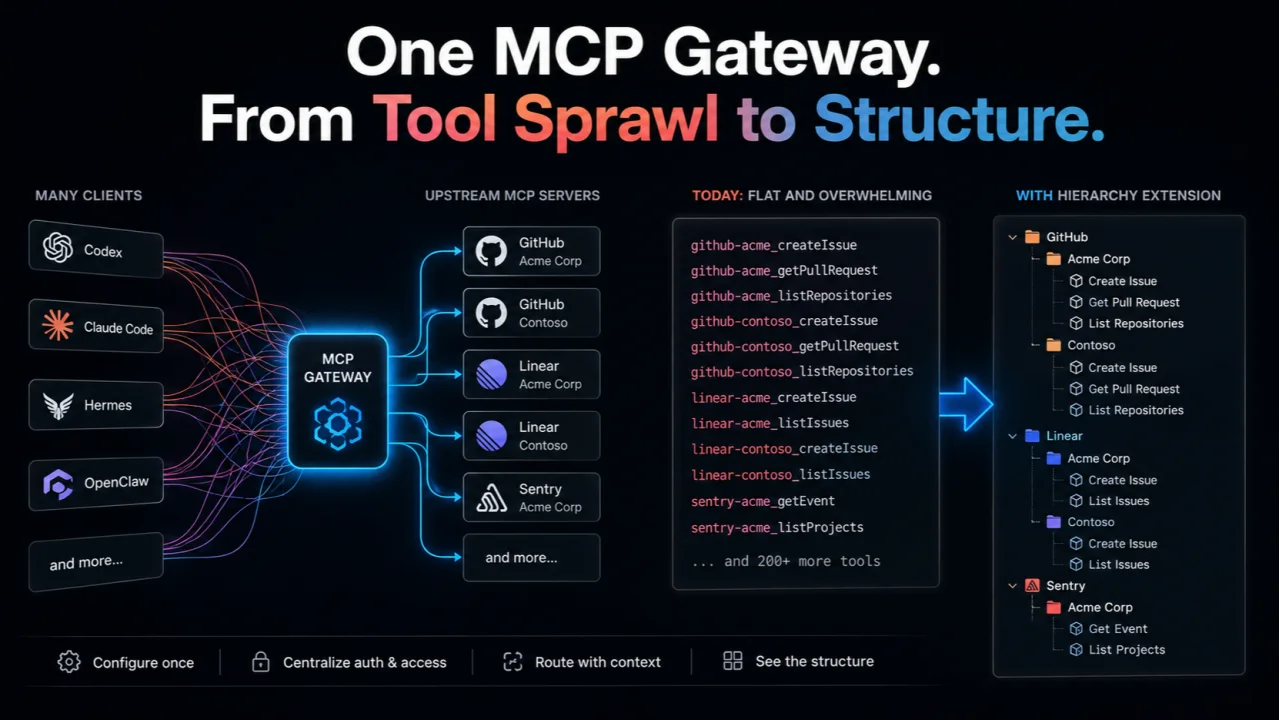
I have spent more time than I care to admit reconnecting the same MCP servers to different AI tools. GitHub goes into Codex, then Claude Code, Hermes, OpenClaw, and whatever else I happen to be testing. Once that is done, I repeat the process for Linear, Sentry, browser automation, documentation, and the rest of the collection.
None of it is especially difficult. Add the server, configure the transport, authenticate, decide which tools should be available, restart something, and remember where that particular client stored its configuration. Then do roughly the same thing again in the next client.
This isn’t a skill I was trying to develop.
MCP standardized how a client talks to a server, but it did not give me one place to maintain the same collection of MCP servers across every environment where I want to use them.
The obvious fix
I have been spending a lot of time experimenting with Cloudflare lately, which is how I came across its MCP server portals. The idea makes immediate sense: maintain multiple upstream MCP servers in one place, expose them through one HTTP endpoint, and connect each AI client to that endpoint instead of rebuilding the same configuration repeatedly.
Conceptually, it looks like this:
Codex
Claude Code
Hermes
OpenClaw
   |
   v
MCP Gateway
   |
   +-- GitHub | Acme Corp
   +-- GitHub | Contoso
   +-- Linear | Acme Corp
   +-- Linear | Contoso
   +-- Sentry | Acme Corp
Call it a gateway, portal, broker, or consolidator. Whatever term eventually wins, centralizing the upstream connections is materially better than maintaining the same MCP estate independently in every client. It gives me one place to manage connections, authentication, access, tool exposure, aliases, and synchronization.
That solves the problem I started with. The tradeoff becomes apparent when I look at what the connected client actually sees.
The gateway knows more than the client
Consider the MCP servers behind that gateway:
GitHub | Acme Corp
GitHub | Contoso
Linear | Acme Corp
Linear | Contoso
Sentry | Acme Corp
Those are not duplicate connections. They may represent different accounts, credentials, organizations, policies, environments, or data boundaries. GitHub | Acme Corp is meaningfully different from GitHub | Contoso, even when both expose a tool called createIssue.
The gateway understands those relationships because it must route every call to the correct upstream server. Cloudflare also preserves some of that context by namespacing tools with the upstream server ID and providing portal_list_servers, which can return the server IDs, names, and enabled state.
The client may still receive one MCP connection containing a list like this:
github-acme_createIssue
github-acme_getPullRequest
github-acme_listRepositories
github-contoso_createIssue
github-contoso_getPullRequest
linear-acme_createIssue
linear-acme_listIssues
linear-contoso_createIssue
sentry-acme_getEvent
That is better than exposing several tools all named createIssue. The prefixes make the tools distinguishable, and I would keep them for clients that do not understand anything more sophisticated. It is still one long, flat list.
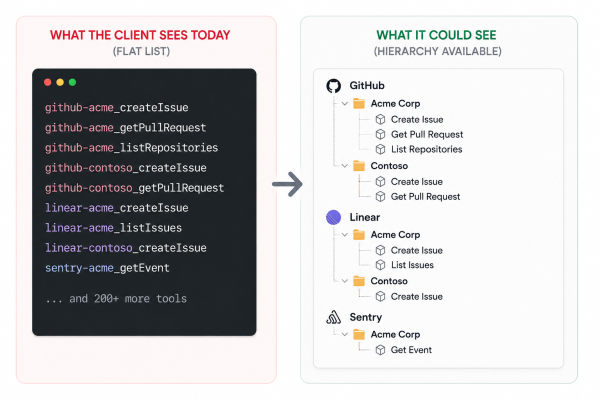
I can infer that:
github-acme_createIssuereally means:
GitHub
  Acme Corp
    Create Issue
The model can probably infer it too. But both of us are reconstructing information the gateway already has in structured form. With five servers, that is manageable. With multiple systems, organizational instances, and hundreds of tools, it becomes another interface I have to mentally organize.
We fixed connection sprawl and replaced it with tool sprawl.
A small extension may be enough
The newer MCP extension mechanism provides a possible way to improve this without breaking existing clients. Extensions are optional and negotiated, so a client and server can use richer behavior when both support it while everyone else continues using ordinary MCP.
My first instinct was to imagine a broad gateway extension covering upstream discovery, health, authentication, policy, routing, schema changes, and every other detail a consolidator might eventually expose. That is probably the wrong place to begin. Most of those may be legitimate future problems, but they are not necessary to solve this one.
For a first version, I think we only need an ordered hierarchy path attached to each tool:
{
  "path": [
    {
      "id": "github",
      "title": "GitHub"
    },
    {
      "id": "acme",
      "title": "Acme Corp"
    }
  ]
}
The existing MCP tool definition already supplies the leaf, including the tool name, display title, description, and input schema. A supporting client could combine the normal tool definition with that path and render:
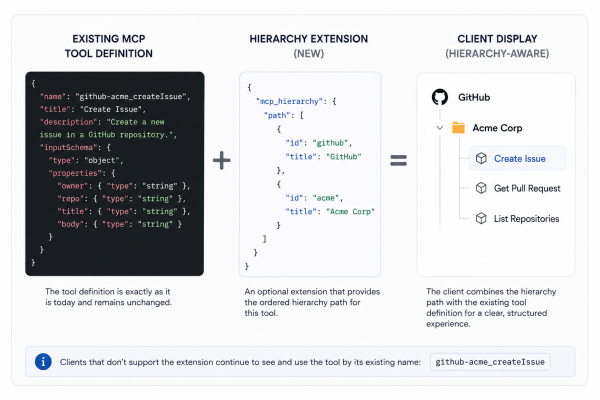
The user still configures one MCP connection. The gateway still exposes and routes the same tools. The client simply receives enough information to organize them.
That could be the entire first version. No separate topology API, no second catalog, and no attempt to standardize every gateway capability at once. Just a path attached to the tool definition the client already receives.
One shared extension, not another private format
The useful outcome would not be a Cloudflare-specific hierarchy followed by separate Kong, Solo, and open-source versions. That would recreate the same fragmentation we are trying to remove.
It should be one small, openly defined MCP Hierarchy Extension that gateways emit and clients consume consistently. Someone would need to write the first draft, publish the schema, and build a reference implementation, but success would mean the extension no longer depended on whoever started it.
Existing clients would continue receiving deterministic names such as:
github-acme_createIssueA client that supports the shared hierarchy extension would receive the same callable tool but could display it as:
GitHub
  Acme Corp
    Create Issue
That gives us a practical adoption path. Extension support improves the interface, but it is not required for the underlying tool to remain usable.
What happens with a gateway behind another gateway?
An ordered path also keeps the design simple when one MCP gateway sits behind another:
Client
  |
  v
Enterprise MCP Gateway
  |
  v
Department MCP Gateway
  |
  v
GitHub | Acme Corp
The inner gateway could attach the GitHub > Acme Corp path. An extension-aware outer gateway would preserve it when republishing the tool rather than flattening everything a second time.
The outer gateway should not automatically add itself and turn the display into:
Enterprise Gateway
  Department Gateway
    GitHub
      Acme Corp
        Create Issue
Those gateway names describe the physical request path, not necessarily something useful to the person selecting a tool. If the outer gateway represents a meaningful logical grouping, such as Production, it could deliberately prepend that level. Otherwise, it should preserve the hierarchy it received.
The rule can remain simple: preserve the upstream path, and only add a parent when it has real user-facing meaning. Routing chains belong in tracing and operational telemetry, not in the tool browser.
The difficult part is adoption, not implementation
I could draft the extension, build a gateway that emits it, and modify a test client to display the hierarchy. That would not suddenly make Claude Code, Codex, Hermes, OpenClaw, Cloudflare, or every other MCP implementation understand it. Gateway and client developers would each need to choose to support the same extension.
Until then, existing clients would continue displaying namespaced tools exactly as they do today. That is not a dead end. It is the backward-compatible deployment path:
Normal MCP client
  Receives github-acme_createIssue
  Calls it normally

Extension-aware client
  Receives the same tool
  Reads the hierarchy path
  Displays GitHub > Acme Corp > Create Issue
The first implementation only needs to prove those two cases. It would demonstrate that a gateway can preserve useful organization without changing how the underlying tools are called or requiring an ecosystem-wide migration.
Who knows, maybe I will try drafting the shared extension, publishing the schema openly, and building a reference implementation on Cloudflare Workers. The initial experiment would be deliberately small: prove that ordinary clients remain compatible, then prove that one extension-aware client can render the hierarchy.
Or maybe Cloudflare gets there first.
Am I missing a good reason an MCP gateway should flatten information it already has? And even if the fix is this small, does it matter enough for gateway and client vendors to implement it?